
Invisalign vs Braces: Which Is Better?
Choosing between Invisalign and braces usually comes down to what you are willing to trade off. Clear aligners let you eat whatever you want and skip the "metal mouth" look,…
On this page
- Key Takeaways
- Quick Comparison: Invisalign vs. Braces
- Invisalign vs Braces: What’s the Difference?
- Is Invisalign Better Than Braces for Adults?
- When Are Braces the Better Choice?
- Invisalign vs Braces Cost: Which Is More Affordable?
- Invisalign vs Braces: Which Is More Comfortable?
- Invisalign vs Braces: Which Is Easier to Keep Clean?
- Treatment Time: Invisalign vs Braces
- Who Is Invisalign Best For?
- Who Should Choose Braces?
- Invisalign vs Braces: Which Should You Choose?
- Orthodontics at 97 Smiles: What to Expect
- Ready to figure out your plan?
- Frequently Asked Questions
Choosing between Invisalign and braces usually comes down to what you are willing to trade off. Clear aligners let you eat whatever you want and skip the “metal mouth” look, but they demand a ton of daily self-discipline. Braces, on the other hand, sit on your teeth full-time. They can feel bulky and draw attention, but they work around the clock without you having to track hours or hunt for lost cases.
Both options get you to the same end goal: a straight, healthy smile you feel good about showing off. So which one should you go for? To help you figure out which compromise makes sense for your daily life, here is how they stack up on cost, daily comfort, maintenance, and actual treatment speed.
Key Takeaways
- Invisalign fits around your lifestyle if you stay disciplined. You won’t have to change your diet or hide your smile in photos, but if you leave trays on your nightstand, your treatment stalls.
- Braces remove the guesswork. They aren’t invisible, and food will get stuck in them, but you never have to worry about misplacing your appliance at lunch.
- Tricky teeth often need fixed brackets. Heavy crowding or deep bite issues usually move more predictably under the constant pull of wires.
- Pricing is closer than most people think. Insurance and payment plans keep monthly costs comparable for both options.
Quick Comparison: Invisalign vs. Braces
| Feature | Invisalign (Clear Aligners) | Metal Braces |
| Look | Smooth, clear plastic that sits flat against teeth | Visible metal brackets and wires across your smile |
| Daily Hassle | Pop them out every time you eat or drink (except water) | Watch out for sticky or hard foods that pop off brackets |
| Wear Time | Needs 20 to 22 hours of daily wear to actually work | Works 24/7 without you doing a thing |
| Cleaning | Take them out to brush and floss your teeth normally | Thread floss under wires and brush around metal brackets |
| Best For | Mild gaps, minor crowding, and busy adult routines | Severe bite issues, rotated teeth, and tricky alignment |
| Average Time | 12 to 18 months (if you wear them consistently) | 18 to 24 months |
Invisalign vs Braces: What’s the Difference?
At the end of the day, both systems do the exact same basic job: they push bone and tissue so your teeth slowly shift into better positions. The real difference is how much control you have over the process day-to-day.
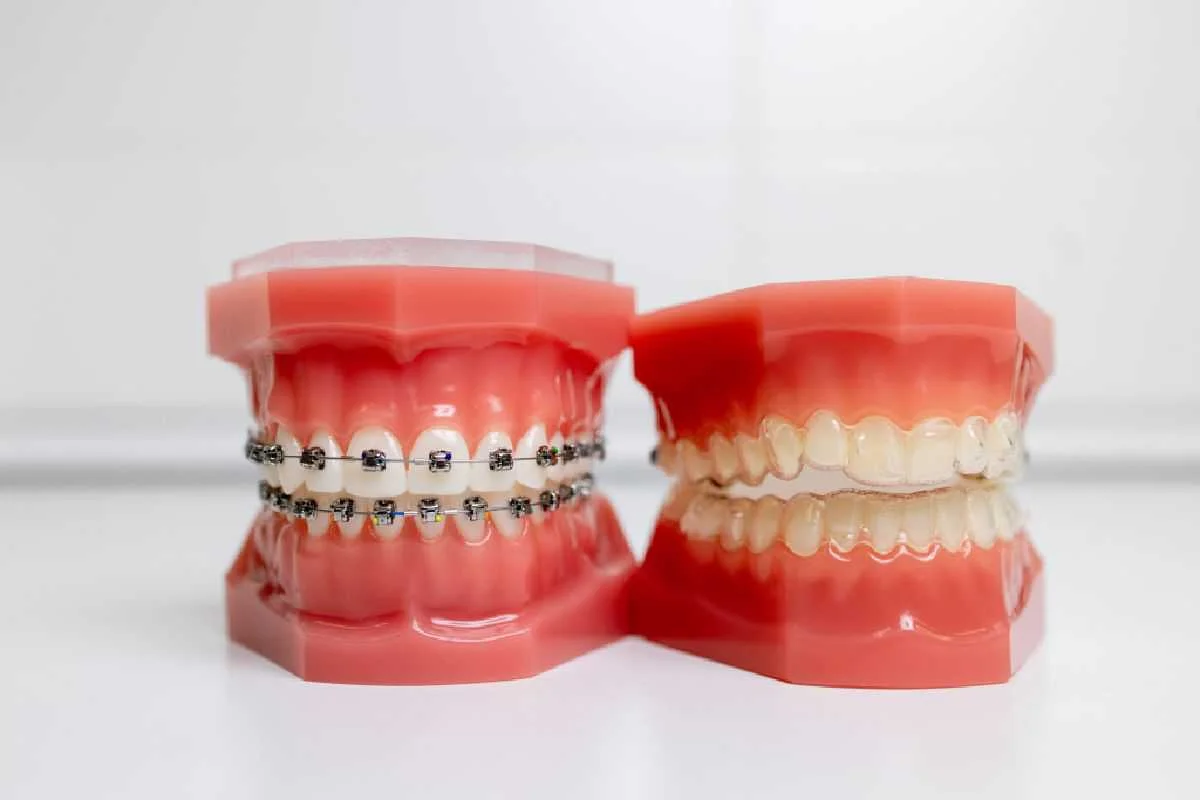
Invisalign uses a series of clear plastic trays tailored to your mouth. You wear each set for a week or two, let it do its job, and then step up to the next tray in the series. Because you can pop them out whenever you want, you get complete freedom at mealtimes. But that freedom comes with a catch: if the trays spend more time in their case than on your teeth, nothing moves.
On the other hand, braces use small metal brackets bonded directly to your enamel, linked together by an archwire. Your dentist tightens that wire during routine checkups to guide your teeth into place. You can’t take them off for a date or a big meeting, but that fixed design means they work constantly, whether you are thinking about them or not.
Is Invisalign Better Than Braces for Adults?
For a lot of adults, the thought of walking into a work presentation or a wedding with metal brackets feels uncomfortable. That concern alone drives thousands of people toward clear aligners every year.
Aligners sit right against your teeth, so most people won’t even notice you have them in during video calls or coffee chats. They also save you from the awkward moment of trying to pick spinach out of metal brackets after lunch with a coworker. You just remove the trays, eat your food, brush your teeth, and put them back in.
The real test with Invisalign is your own routine. You have to commit to keeping them in your mouth for 20 to 22 hours every single day. If you tend to leave small things behind at restaurants, or if you know you’ll get lazy about putting them back in after your morning coffee, braces might actually save you time and frustration in the long run.
When Are Braces the Better Choice?
Clear aligner tech has come a long way, but fixed braces are still the workhorse of orthodontics.
Because brackets attach directly to each individual tooth, your dentist has direct leverage to pull, turn, or lift teeth into place. Braces are usually the better call if you have:
- Severe crowding where teeth overlap heavily
- Teeth that are twisted or rotated sideways
- Large gaps or deep bite misalignments
Braces are also a lifesaver for teenagers (and plenty of adults) who struggle to keep track of their belongings. Fixed braces mean zero lost trays, zero hunting under car seats, and no worrying about whether you logged enough wear hours this week.
Before picking a treatment path, make sure you feel confident in the person managing your care. Take a look at our guide on How to tell if a dentist is good or not so you know what questions to ask at your first visit.
Invisalign vs Braces Cost: Which Is More Affordable?
Most people assume Invisalign costs twice as much as braces, but that isn’t really true anymore. Total pricing for either option usually lands between $3,000 and $7,000.
Your actual price tag depends mostly on:
- How far your teeth need to move
- How long your treatment takes
- The specific practice you visit
Insurance and Monthly Payments
Most dental plans that cover orthodontic treatment treat aligners and metal braces the same way, paying out a fixed benefit amount for either choice.
At 97 Smiles, we keep pricing upfront and offer payment plans to spread out costs over time, because managing your budget shouldn’t stand in the way of fixing your smile.
Invisalign vs Braces: Which Is More Comfortable?
We won’t sugarcoat it: moving teeth hurts a little bit, no matter which system you pick. That dull ache just means the pressure is working and your teeth are starting to move into place.
That said, the type of discomfort feels pretty different between the two options.
What to Expect During Week 1
Invisalign: Firm pressure on teeth; smooth against cheeks; tight tray feel
Metal Braces: Mild tooth soreness; brackets rub cheeks; wax helps smooth edges
Metal brackets sit directly against the delicate skin inside your lips and cheeks. It usually takes a couple of weeks for your mouth to toughen up, and you will probably use a fair amount of soft dental wax to cover rough spots early on.
Meanwhile, Invisalign trays are made of smooth plastic, so they don’t scrape the insides of your mouth. You will feel a strong, tight squeeze for the first couple of days after stepping into a fresh tray, but your cheeks and gums won’t feel raw.
Invisalign vs Braces: Which Is Easier to Keep Clean?
This is usually where Invisalign wins people over for good.
Since you take your trays out to brush and floss, your morning and nighttime bathroom routines stay exactly the same. You just brush your teeth, scrub your trays with cool water and a soft toothbrush, and pop them back in.
Daily Hygiene Realities
Invisalign Care:
1. Pop trays out
2. Brush and floss your teeth normally
3. Scrub trays with water & soft brush
4. Put them right back in
Braces Care:
1. Brush carefully around every bracket
2. Thread floss under the main wire
3. Clear trapped food with a tiny brush
4. Rinse and check for missed spots
Braces take significantly more time and patience. Food loves to hook onto brackets and slip under wires, especially after eating things like bread or leafy greens. If you skip careful flossing or rush through brushing, plaque builds up fast around the brackets, which can leave permanently discolored spots on your enamel once the braces come off.
Solid habits make orthodontic care much easier to handle. Check out our article on What Is the 50-40-30 Rule in Dentistry? to simplify your daily routine.
Treatment Time: Invisalign vs Braces
Most treatment plans wrap up somewhere between 12 and 24 months.
Invisalign can handle simple spacing or minor crowding quickly, sometimes in as little as 6 months, because the plastic tray hugs the entire surface of each tooth, putting pressure on every side at once. But that timeline completely relies on you. If you take your aligners out for dinners, events, or long afternoons, your progress halts instantly.
Braces move at a steady, uninterrupted pace. For complex bite adjustments or stubborn tooth turns, braces often finish faster simply because they exert direct, continuous force 24 hours a day.
Who Is Invisalign Best For?
Clear aligners are usually the right match if you:
- Want a low-profile treatment that doesn’t stand out in photos or meetings
- Only need to fix mild spacing or light crowding
- Feel confident you’ll actually wear your trays 20 to 22 hours every single day
- Don’t want to change the foods you eat
- Want to keep your standard brushing and flossing routine
Who Should Choose Braces?
Braces are usually the smarter pick if you:
- Have severe overcrowding, rotated teeth, or a tricky bite to fix
- Prefer a “set-it-and-forget-it” system that works without extra daily effort
- Are picking treatment for a teen who might misplace loose trays
- Want a predictable path for complex teeth movements
Invisalign vs Braces: Which Should You Choose?
It really comes down to which set of trade-offs fits better into your life.
If you want hidden appliances, easy cleaning, and normal mealtimes, and you know you have the discipline to keep the trays in, go with Invisalign. If you have a complex case, or you just don’t want to deal with tracking hours and taking trays out every time you eat, choose braces.
The best next step is an in-person look. A dentist can scan your teeth, show you what each option looks like, and help you make the call.
Orthodontics at 97 Smiles: What to Expect
Choosing to align your teeth is a big commitment, and nobody wants to feel judged or pressured into a treatment that doesn’t fit their life. We built our practice around making dental care straightforward, welcoming, and accessible.
When you come in for an orthodontic consultation at 97 Smiles, here is how we handle things:
- Clear, upfront treatment plans: We run 3D digital scans of your mouth so you can see exactly what needs to move and why. We explain both aligners and braces fairly, no pushy sales pitches for the more expensive option.
- Transparent pricing and flexible payment options: You won’t run into hidden add-on fees mid-treatment. We offer clear cost structures, with many treatments starting at $97, alongside flexible financing plans that keep your monthly payments manageable.
- Modern technology in a judgment-free space: Whether it’s been six months or six years since your last dental visit, our team focuses on where your smile is going, not where it’s been. We use digital imaging instead of messy, uncomfortable putty impressions to keep your visits quick and smooth.
- Multiple convenient locations: Straightening your teeth involves routine check-ins, so we make it easy to drop by a location close to your home or work without tearing up your entire schedule.
Ready to figure out your plan?
At 97 Smiles, we offer clear treatment plans, simple financing, and options starting at $97. Schedule your consultation today to see which treatment fits your life best.
Frequently Asked Questions
Is Invisalign faster than braces?
For mild spacing, Invisalign can be faster. But for complex bite fixes or severe crowding, braces usually finish the job quicker. Your actual timeline depends heavily on how much your teeth need to move and whether you keep your aligners in all day.
Are braces cheaper than Invisalign?
Braces used to be significantly cheaper, but today prices are often quite close. Your total cost has more to do with how long your treatment takes than which option you choose.
Can I switch from Invisalign to braces later?
Yes. If clear aligners aren’t moving your teeth as quickly as planned, or if keeping track of daily wear time proves too difficult, your dentist can move you into fixed braces to finish up.
Do clear aligners hurt less than braces?
Aligners usually cause less soft-tissue irritation because they don’t have metal brackets rubbing against your cheeks. That said, you will still feel tight, dull pressure whenever you switch to a fresh set of trays.
Do I really need a retainer after treatment?
Yes, absolutely. Teeth naturally try to drift back to their old positions over time. Wearing a retainer after both Invisalign and braces is the only way to keep your smile straight long-term.


